

Summary
Displays can be standalone posters, museum exhibits, conference presentations, or any other form of infographic that combines stories, data, and visuals. They can be displayed on their own to accompany other visuals or information, acting as supplemental resources to elaborate on a topic. Or a presenter can use them to efficiently communicate their research or projects by telling a story through visual media.
Exhibits
This class assignment was to design a poster around a proposed museum exhibit. This poster would educate a general audience visiting the National Museum of Nuclear Science & Medicine about the direct complications of radiation exposure. The poster was designed to be accompanied by additional displays about acute radiation syndrome, however this particular display focuses only on CRS. The poster explains the pathology of CRS and provides major historical events for reference. An accompanying animation, which was not required to be created for the class assignment, would be displayed on a screen in the exhibit. The animation would use the hand model and textures from the poster to show the progression of each stage of CRS.

The project was documented to show the research, planning, and build process. The document can be viewed and downloaded here.

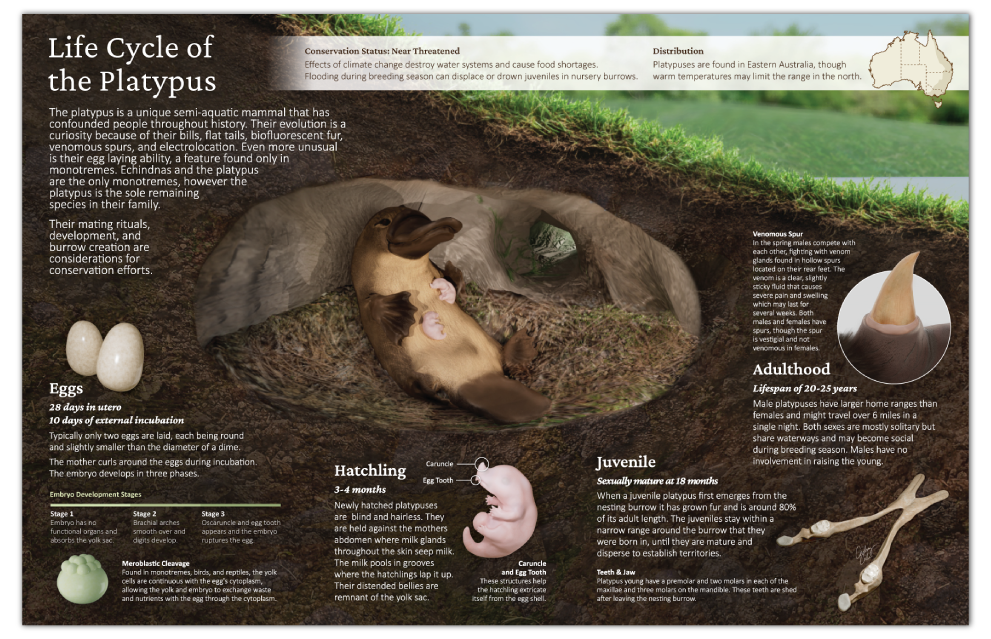
Another exhibit piece I created was a poster for the life cycle of the platypus. This large format poster was designed to highlight the development and unique characteristics of the platypus, and relate the information to the conservation efforts of this adorable animal. The models were created in Zbrush, with textures developed in Adobe Substance painter, with everything imported into Cinema 4D for composition and lighting. Post processing was implemented and layout was composed in Adobe Illustrator.
Conference Presentation
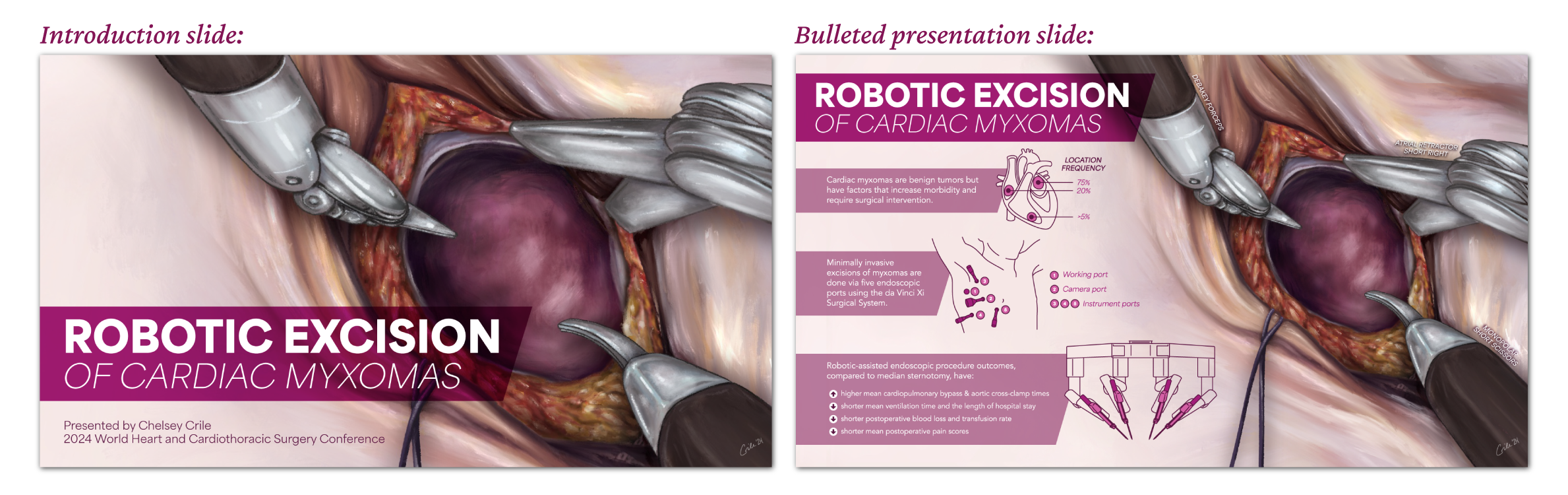
This mockup was created with the 2024 World Heart and Cardiothoracic Surgery Conference in mind, where a proposed presenter would discuss the research of robotic assisted endoscopic surgeries to excise cardiac myxomas. The illustration showcases the instruments used by the da Vinci Xi surgical system, gives an overview of why surgical intervention is necessary, and compares robotic surgery to that of the conventional approach (median sternotomies).
There were three versions designed for different use cases:
- A beauty slide is meant to highlight the tools and the myxoma, which could be used as an introduction slide in a powerpoint.
- The presentation slide has bulleted text and icons summarizing the topic.
- A stand-alone version has full text and icons that allow for the reader to understand the data at their own pace.

 Chelsey Crile