

Summary
Scaffolding information for learners improves the learning experience and can increase understanding of the material. Whether it be an interactive module, a textbook, or printed handout, guiding the learner through the material helps them effectively achieve their academic goals.
E-learning Modules
At BodyViz, I created e-learning modules while utilizing images obtained from the BodyViz 3D software and custom illustrations. The BodyViz software took real DICOM images and reconstructed them in 3D. It allowed users to filter structures based on tissue density, create clipping planes, and place tags on structures to identify them. Part of my role as a Curriculum Content Specialist was to be familiar with this process and understand radiology so I could prepare the scans for learning and build modules around each case.
The modules were often delivered in a series and scaffolded information. They were similar to Powerpoint slides, but included interactions such as drag and drop activities, show/hide features, quizzes, and links to open and explore real anatomy in the BodyViz software.
Projects included undergraduate level anatomy module packages, as well as custom content created for the University of Georgia College of Veterinary Medicine department, Youngstown State, and others.

Video Walkthroughs
The video below is of a module that was to be used alongside MRIs of the hand and wrist. The illustrations and interactions in the recording were made to supplement these scans and isolate the muscle layers that were specifically requested in the Youngstown State lecture materials. The carpal tunnel was another topic of study for this module.
The video of the module below was a case study module created for UGA had clickable steps to teach students the hand placements and movements used to perform a cranial drawer thrust and tibial thrust test.
Surgical Illustrations
This didactic illustration was created to show the steps in an innovative surgical procedure, for a potential journal publication. Reverse shoulder arthroplasty is a surgical procedure where the humeral head and glenoid are replaced with hardware, but reversing the normal ball-and-socket structure of the shoulder joint. I chose to focus on the preparation of the humeral head for the fitting of the prosthetic implant.

Figures
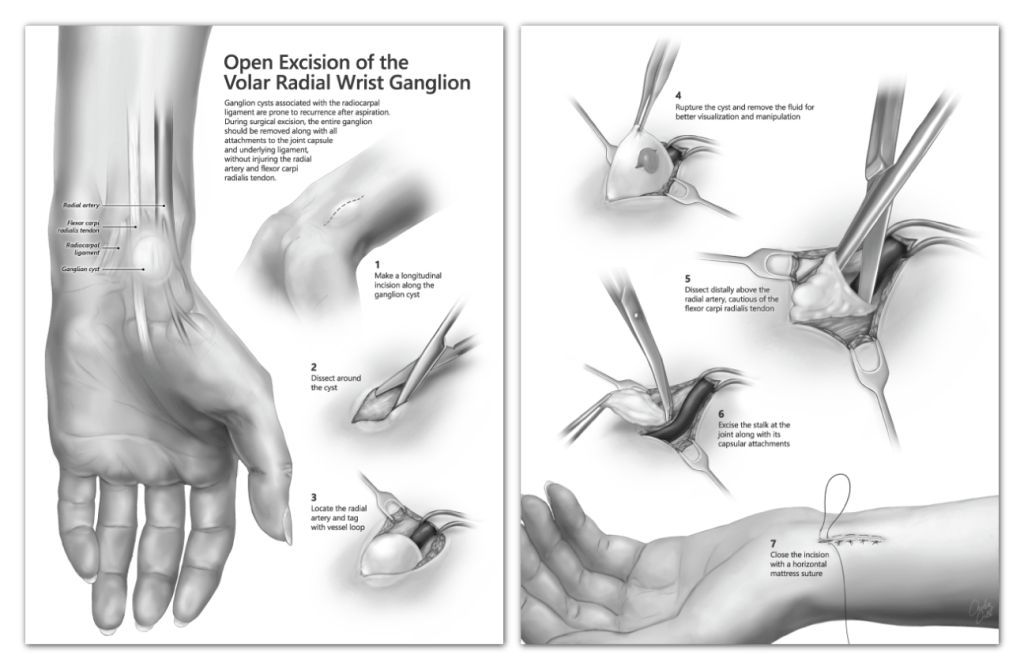
This two page grayscale illustrated document shows the steps in a surgical procedure to excise ganglion cysts that arise from the radiocarpal ligament. Research for this illustration included multiple videos and journals. The large wrist illustration on the first page was included to educate the audience on the anatomical landmarks they must be cautious of during the procedure. The step-by-step instruction simplify the dissection of the cyst and closure of the wound. The intended use for such a didactic is as figure illustrations with an academic journal or textbook.
Handouts
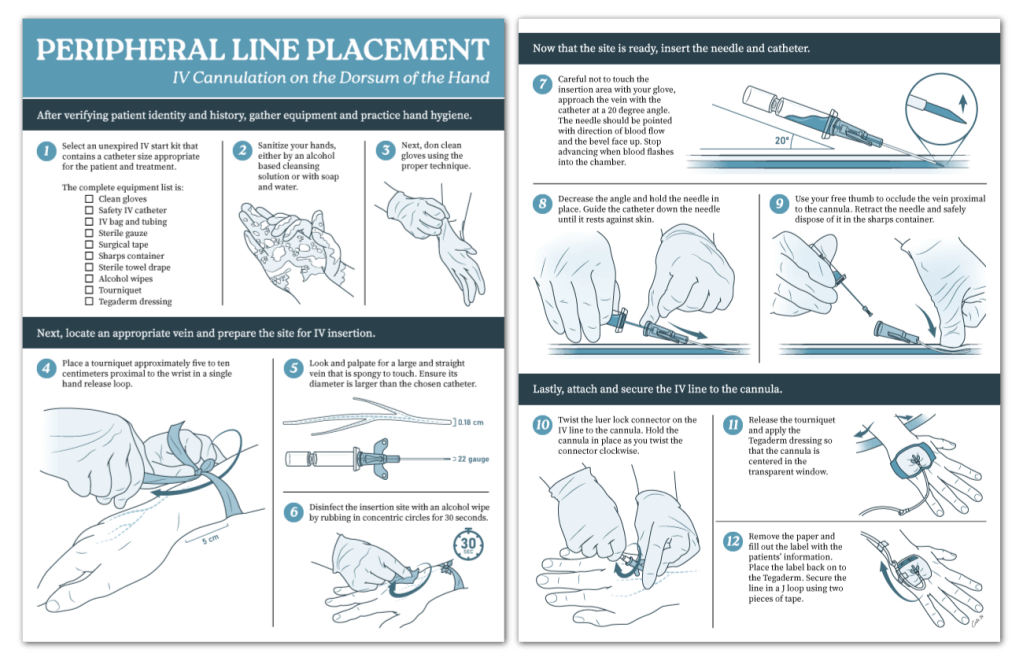
This two page instructional document outlines the placement of a peripheral line on the dorsum of the hand. As this was created for medical and nursing students at the UIC Simulation and Integrative Learning Institute, medical terminology was used and the steps about hand hygiene and tourniquet placement were simplified. Choosing a properly sized vein for the catheter gauge was stressed as differently sized gauges are needed for specific procedures.
The illustrations highlight the importance of each step and the use of arrows guides the reader through the motions performed. Students should be able to follow the procedure using the illustrations, though the text for each section provides further valuable information. The document was created with a monochromatic blue tone but could easily be printed in greyscale without loss of information and provided for students practicing the cannulation.
Additional Case Studies and Work

 Chelsey Crile