

Summary
In the courtroom, jurors have to quickly learn the details of a case. Custom visuals can make the anatomy and pathology of a case more accessible. Illustrations and animations educate the audience and help them make more informed decisions.
Illustration Overlays
Radiographs are diagnostic tools for healthcare professionals, however it takes training and understanding of anatomy to interpret them. Illustration overlays can allow the audience to understand anatomy and pathology.
For this medical legal class assignment, an x-ray was provided for us to interpret. The goal was to clarify the anatomy and fracture for audiences, so they could more easily see the severity of the break and the overlapping of structures.

Anatomical Labeling
Another medical legal class assignment was the interpretation of an MRI slice and the addition of labeling. As this was a central disc herniation case, omitting the abdominal organs from the illustration was a chosen so that jurors may focus solely on the relevant case details. Rather than overlay the illustration directly onto the slice, the original slice is added separately for comparison.

Timelines and Demonstrative Evidence
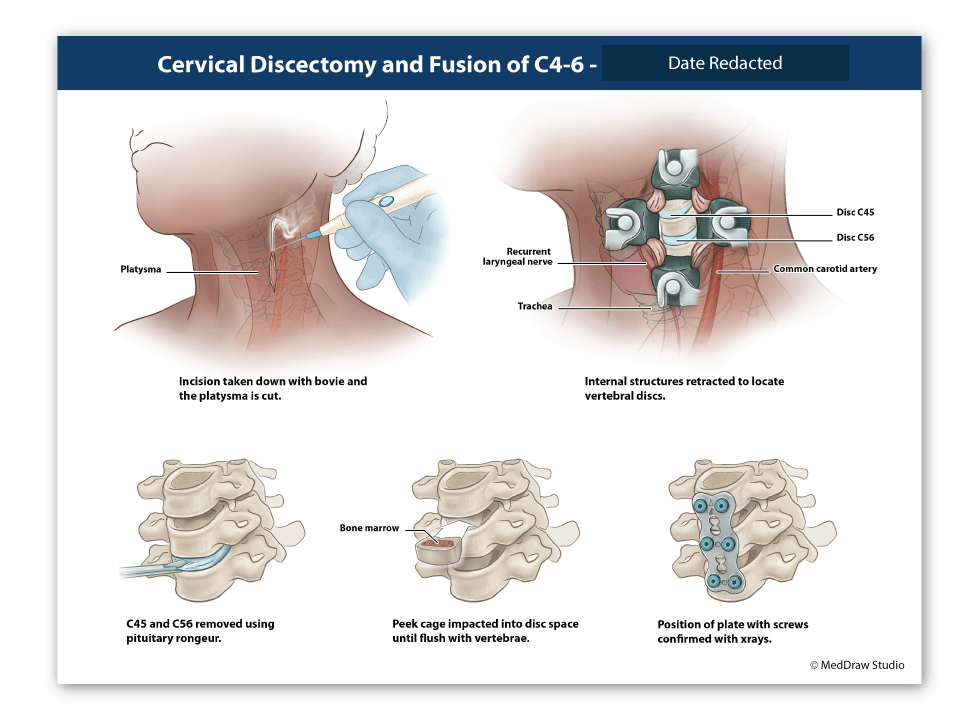
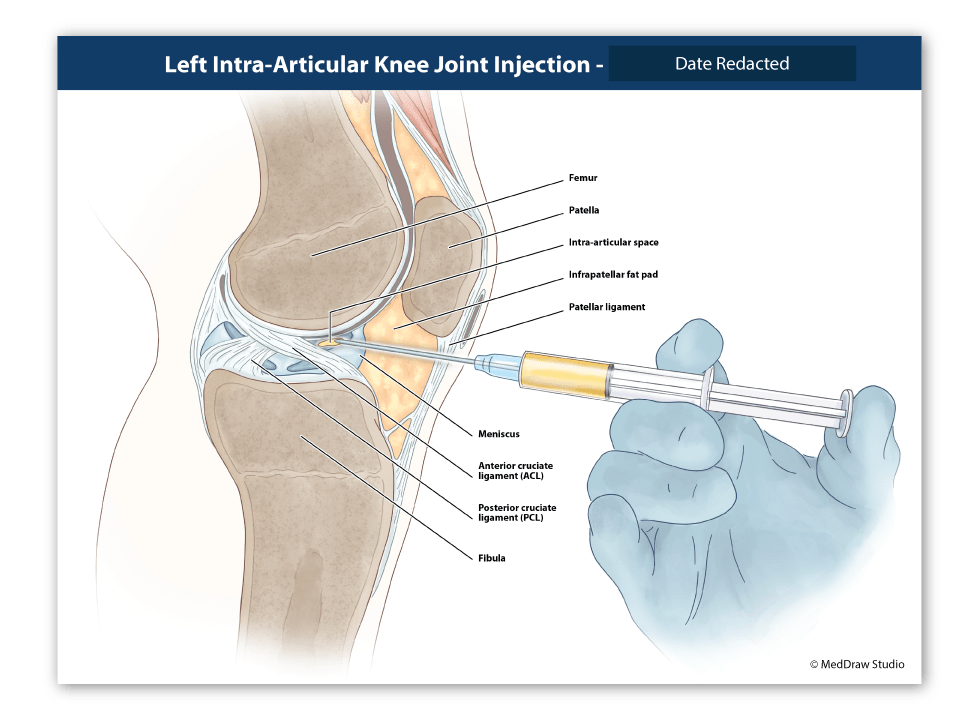
Along with illustration overlays, the creation of supplemental materials is just as important to guide jurors through the facts of a case. Custom illustrations may be used as demonstrative evidence to personalize the case and let jurors visualize the case when actual photos may not be available.
This school project was based on a real case, where I was provided with a complaint filed by the plaintiff, an ultrasound report, and one photo of the plaintiffs lump. As I was to defend the physician in the case, I utilized the case history timeline and presentation of mastitis and breast cancer to inform the jurors why the tumor may have been missed while the plaintiff was being treated.
Timelines are useful for providing jurors with the chronological facts of a case. Educating jurors on the anatomy of a case gives them understanding of the medicine behind it. The illustration can also represent the case and be more accurate than a stock photo. For this particular case, I chose to compare the plaintiff’s mastitis presentation to her symptoms from when she was diagnosed with breast cancer. These side-by-side illustrations highlight the similarities and differences between the two dates.

3D Models and Animations
Models can give jurors an insight into the spatial relation of anatomy, the severity of injury, or understanding of size. Animating these models or incorporating 2D elements, such as illustrations or labeling, tells a story while providing chronological information.
I took an independent animation class that focused on a real case, where the plaintiff had a posterior wall fracture that was repaired. I reviewed the surgical report and the deposition, as well as analyzed the provided radiographs, to recreate the surgery and familiarize the jurors with the ORIF procedure.
Audio was intentionally excluded to provide an opportunity for a speaker to talk over or pause the animation as needed. The pacing of the scenes was slowed to allow the audience to easily follow the procedure and identify the anatomy, fractures, and hardware.
Additional Case Studies and Work
 Chelsey Crile